AI content
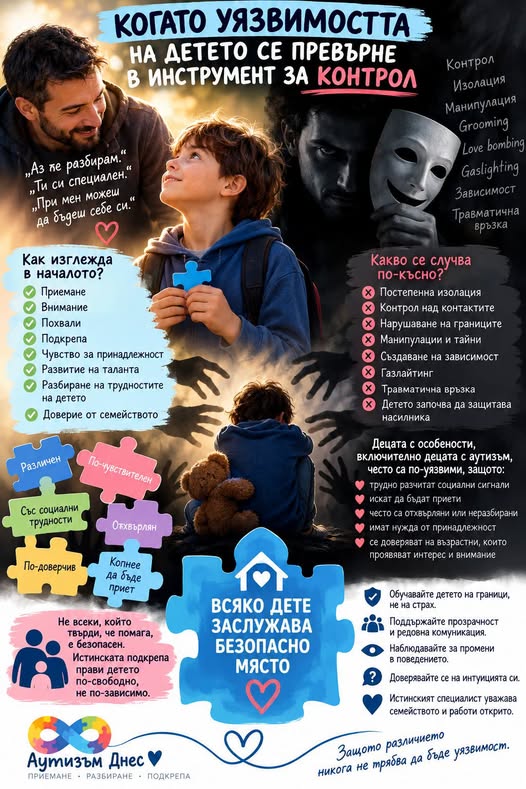
WHEN A CHILD’S VULNERABILITY BECOME AN TOOL OF CONTROL
There are children who find it difficult to find their place among peers.
Children who are different.
More sensitive. More closed. More trusting.
Children with difficulties in social communication, with low self-esteem, with the feeling that no one understands them.
Children who are sometimes rejected, ridiculed or simply remain invisible.
And this is where a particularly dangerous form of psychological manipulation appears.
A predator rarely starts with violence.
It begins with acceptance.
“I understand you.”
“You are special.”
“Others don’t see how much you can do.”
“You can be yourself with me.”
For a child who has long felt rejected, this can be an extremely powerful experience.
Thus begins the grooming—the gradual building of trust, dependence, and access.
But very often it is not only the child that is “processed”.
The family is also processed.
Another image is shown to the parent:
a person who “understands” the child;
a mentor who believes in him;
a person who succeeds where the school or environment has failed;
someone who promises belonging, development, discipline, independence.
And gradually the parent begins to think:
“I finally found someone who accepts my child for who he is.”
This trust can be genuine.
But that’s exactly why it can be dangerous if it falls into the wrong hands.
Then the process can continue with love bombing — excessive attention, special treatment, praise, gifts, adventures, feeling chosen.
Then comes something much quieter:
the isolation.
Fewer friends.
Fewer other adults.
Fewer outside opinions.
Gradually, one person or one group begins to become the whole world of the child.
And when there are not enough “external mirrors” to say:
“This is not normal.”
boundaries may begin to shift.
Next comes coercive control — control not necessarily through physical force, but through relationships:
“Who really understands you?”
“Who can you trust?”
“Which people are against us?”
“Do you choose family or us?”
And gradually the child can become dependent not just on the person, but on the belonging, attention and identity that he receives through him.
And then one of the most difficult psychological phenomena appears — trauma bonding.
The person who causes fear or pain is the same person who then gives attention, comfort, recognition and security.
And the victim can simultaneously:
to be afraid of him
and to love him;
to be hurt
and to protect him;
to want to escape
and to be afraid of losing it.
This is not “nonsense”.
This is a built-in psychological dependence.
Gaslighting follows:
“It didn’t happen that way.”
“You’re exaggerating.”
“Others want to divide us.”
“They don’t understand our relationship.”
And gradually the child — and sometimes the parent — begins to doubt not the abuser, but his own perception.
And then comes the most painful phase.
Cognitive dissonance.
It is extremely difficult for a parent to hold two thoughts at the same time:
“This person helped my child.”
and
“It’s possible that this person was hurting him.”
The second thought brings with it unbearable questions:
“How did I not see?”
“Why did I trust him?”
“Did I let this happen?”
“Could I have prevented it?”
And sometimes the psyche chooses the less painful explanation:
“It can’t be true.”
Then:
“He’s being attacked.”
Then:
“Everyone else is lying.”
And we arrive at one of the most paradoxical phenomena in the psychology of violence:
the victim or relatives begin to protect the person from whom they should be protected themselves.
This is why society is very careful with children who are “different”.
A child with autism.
A child with social difficulties.
A child who has no friends.
A child who has been rejected.
A child longing for someone to finally tell him:
“I accept you.”
This child should not be taught to fear the world.
It must be taught boundaries.
Acceptance does not mean unconditional trust.
Support requires no secrets.
A real specialist does not isolate the child from the family and other people.
A healthy relationship does not require a child to choose between “us” and “them.”
And the person working with a vulnerable child must embrace transparency, scrutiny and professional rules—not be afraid of them.
Because the most dangerous predator does not always look scary.
Sometimes he looks like a savior.
And that is why our task as parents, specialists and society is not to teach children not to trust anyone.
And let’s teach them to recognize the difference between:
acceptance and obsession;
support and control;
proximity and violation of boundaries;
mentorship and dependency.
At Autism Today, we believe that difference should never become a vulnerability that someone can exploit.
Acceptance should make the child more free.
No more dependent.
Because every child deserves more than just a place.
It deserves a safe place.
#AutismToday #ChildSafety #Boundaries #Grooming #PsychologicalSafety #Acceptance #Autism #ChildProtection See less